
By: The Capella University Editorial Team
Reading Time: 8 minutes
Strong communication is a valuable skill in any workplace. Whether you’re leading a meeting, collaborating on a project or connecting with clients, the way you share ideas – and how well you listen – can make a real difference in how you work with others. Clear, thoughtful communication helps teams stay focused, build trust and reach shared goals.
Education can provide a supportive way to strengthen your communication skills, refine your message and apply what you learn in the real world. Explore why communication matters and how developing these skills through education can help you grow personally and professionally.
Communication skills ensure your message is understood as you intend, whether you’re speaking, writing or presenting.
In the workplace, communication spans in-person and online meetings, reports, presentations and everyday conversations. Professionals who adapt their communication style to different settings often find it easier to connect and collaborate.
Communication, like motivation and adaptability, is a soft skill. These non-quantifiable, subjective skill sets may help when applying for jobs. You may have similar experience and education as other candidates, but good communication skills may help you land the role.
With these skills, you can explain complex concepts clearly, write concise reports, and adjust your communication style and tone to different audiences. They also help you integrate quickly into teams and establish credibility.
Effective communication among employees, clients, leaders and stakeholders drives productivity, innovation and competitiveness.
To be effective, however, communication requires more than speaking and listening. There are four different types of communication you can strengthen.
Together, these modes of communication shape how effectively we connect at work.
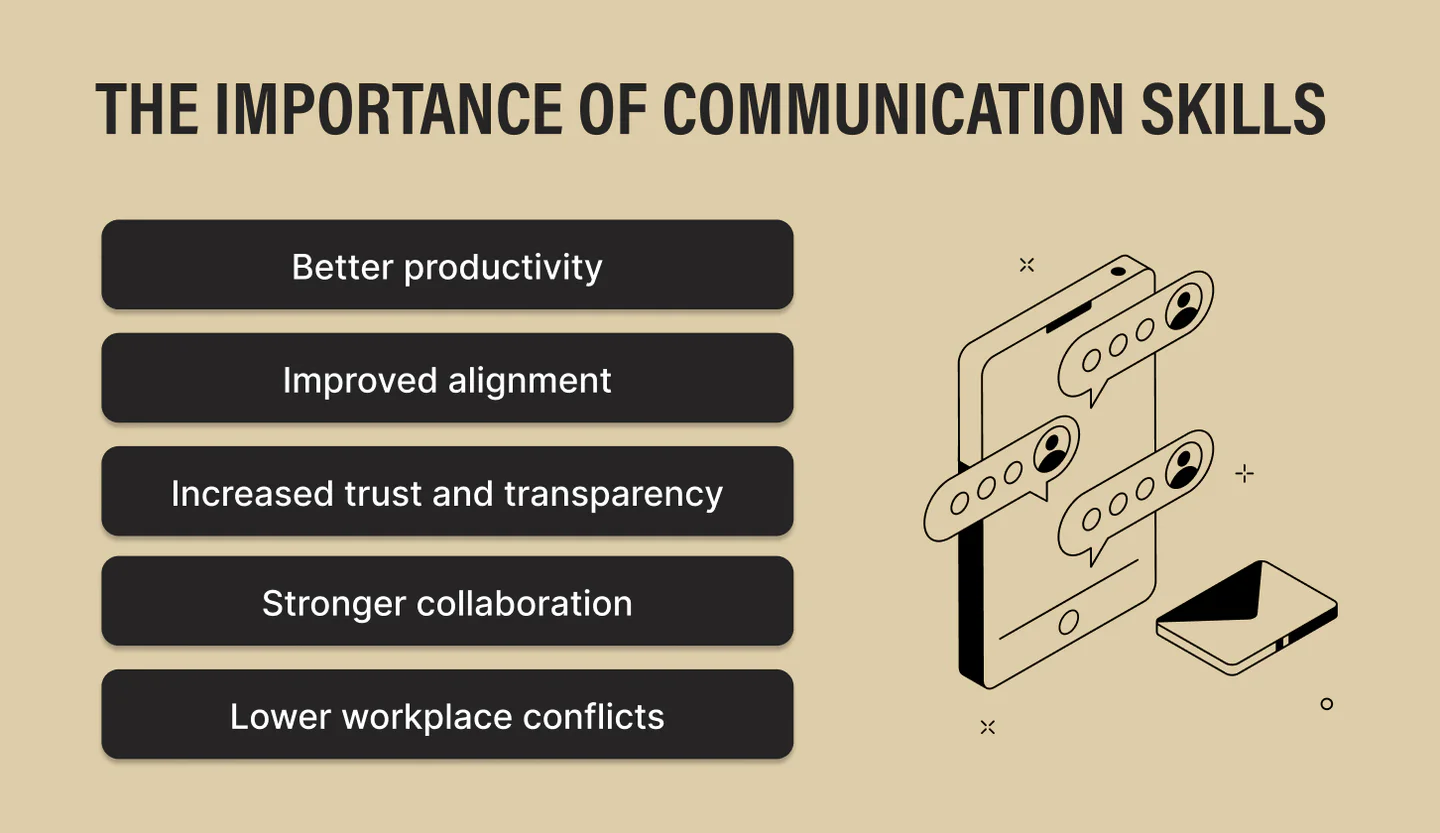
Good communication can serve as the foundation of productivity, collaboration and professional growth. Teams that communicate clearly tend to be more productive, less stressed and better aligned.
Strong communication isn’t just a skill, it’s an advantage. But how do you develop effective communication skills?
Focus on these seven vital elements to become an excellent communicator at work:
Whether you’re writing an email, presenting at a meeting, collaborating with a member of another team or speaking with a customer, adapt your message to suit your audience.
For example, someone who works in the information technology field needs to be able to pitch a project to an executive. The message should not get bogged down with technical details.
At the same time, the IT professional needs to communicate instructions that will make sense to the production and development team. So, they can’t just say, “We need to make the system faster.” They must be detailed, specific and structured.
A good communicator should be a good listener. In conversation, resist the temptation to formulate a reply in your head before the speaker is done talking. This can prevent you from fully understanding the message.
Instead, spend that time actively listening to them, and use both nonverbal and verbal listening responses to show you’re paying full attention to the speaker. These can include follow-up questions, paraphrasing what they’ve said to ensure you’ve understood and using nonverbal cues like nodding, eye contact and leaning forward.
Be concise and clear in your communications. If you’re writing an email, put the desired action items for the recipient in the first few lines. Then use the rest of the email to provide context or background.
When you speak in a discussion or meeting, be careful not to ramble on. And make sure what you have to contribute is relevant to the entire group. If it’s not, save it for a one-on-one conversation.
Professional writing must be clear, accurate and error-free. Check your spelling, use proper grammar and avoid industry jargon. Proofread your work before you send it. This applies to emails, presentations, memos, reports, blogs – any form of written communication in the workplace
Understanding and using nonverbal communication effectively often conveys more meaning than the words you use.
For example, maintaining eye contact during a meeting shows engagement, while nodding subtly lets the speaker know you’re following along. Positive nonverbal cues like smiling can help build stronger workplace relationships, which in turn makes collaboration smoother.
Leaders also rely on nonverbal cues to motivate the team and project confidence. A relaxed but upright posture signals authority without intimidation, while an open stance (arms uncrossed, leaning forward) shows approachability.
Mastering nonverbal cues allows you to strengthen your messages, avoid misunderstandings and build trust.
Good verbal communication and interpersonal skills are essential for collaborating with others, your team, customers or clients. Speak clearly, concisely and loudly (but not too loudly), with a focus on building a good rapport with your audience.
To build your verbal skills, focus on:
Your job may call for you to present in a meeting or at a conference. The key to delivering a presentation is preparation. Conducting your research, then writing, rewriting and practicing your presentation, will help you prepare to nail the delivery.
Your presentation skills also rely heavily on good verbal and nonverbal skills. Many companies offer internal training to help improve their employees’ presentation skills.
You can build your presentation skills through Capella University’s skills-based education programs. You can also find training opportunities for public speaking or look for online presentation tips and tricks.
Empathy and emotional intelligence are crucial to effective communication, especially in leadership.
For example, when a topic is complex or sensitive in nature, it’s sometimes best to pick up the phone, have a face-to-face conversation or schedule a phone or video call, rather than sending an email.
Leaders who acknowledge concerns and invite dialogue build trust. For example, during an organizational change, hosting an open Q&A shows understanding and transparency, while a formal update alone may not.
Connecting personally with your coworkers can also help build rapport and establish trust. This will improve collaboration going forward.
Mastering these seven building blocks of communication may help you excel, but communication also plays a role in your professional development.
Your resume is often your first demonstration of communication skills. Employers notice clarity, accuracy and professionalism before they ever meet you.
Show your ability by highlighting how your communication led to results with accomplishment-focused bullet points. For example: “Secured executive approval with one presentation and delivered project 10% under budget.”
Cover letters offer more room to expand on these examples. Customizing each resume and cover letter to the job shows attention to detail and effective communication.
Before submitting, ask someone you trust to review your documents. They can help catch any mistakes or sections that could be improved. You can also read your cover letter and resume out loud to see if it flows correctly. These steps take time but can make the difference in communicating why you are the best fit for a role.
The interview itself showcases verbal and nonverbal skills. Capella University students and alumni have access to career development resources and one-on-one career coaching that can help them showcase their skills effectively on resumes, in cover letters and in interviews. Our Career Development Center offers additional support for practicing interview skills.
Strong communication is one of the most valuable skills you can bring to any workplace. It helps you connect with others, share ideas clearly and stand out for new opportunities.
At Capella University, you’ll find flexible online programs designed to help you sharpen practical abilities like communication while earning a degree that supports your long-term career goals. With dedicated academic coaches and career development resources, you won’t have to do it alone.
Good communication skills are a person’s ability to clearly share information, exchange ideas and understand others’ messages. Key traits of a good communicator include active listening, using verbal and nonverbal cues, adapting to your audience and being emotionally intelligent.
The 5 C’s of communication are a classic framework used to strengthen clarity, impact and understanding in any type of communication. Each “C” stands for:
Using the five C’s helps you communicate instructions, present ideas and write messages that are impactful and professional.
Improving communication skills requires practice and self-awareness. You must focus on the seven aspects listed above, including knowing your audience, active listening, being clear and concise and using the right verbal and nonverbal cues.

We've received your message and will get back to you soon.