
By: The Capella University Editorial Team with Irene Abrego Nicolet, PhD, NCSP, LSSP, Dean of the School of Social and Behavioral Sciences
Reading Time: 8 minutes
Sitting through hours of lectures or reading dense course material might not always translate into skills you can actually use at work. Despite studying hard, you may still freeze when the situation in front of you doesn’t match the textbook version.
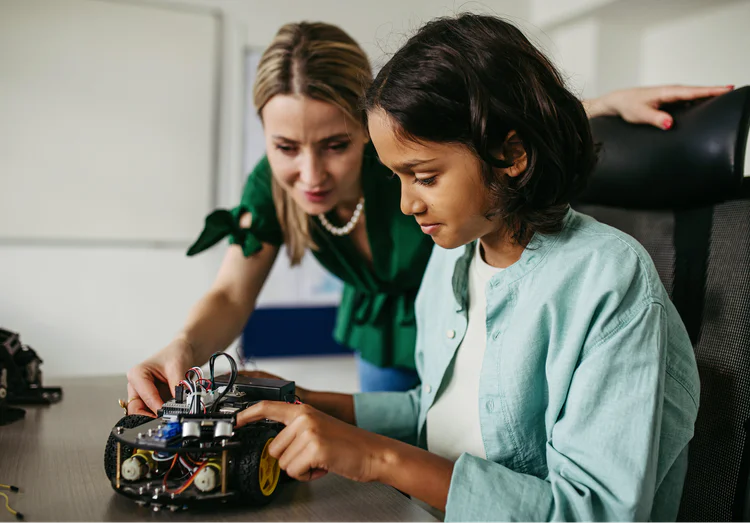
Kinesthetic learning works differently. Learning by doing, practicing and refining puts skill acquisition at the center of how you study. Hands-on practice builds the kind of understanding that holds up when it counts.
Explore how kinesthetic learning works and how hands-on strategies can support your skill development.
Ready to pursue a degree that supports skill development? Explore Capella’s online programs.
Kinesthetic learning is an experience-based approach that involves active participation and physical engagement. The process could involve using movement, building models or running experiments to understand how concepts are used in practice.
While the idea of learning through experience has been around since the early 1900s, Neil Fleming’s VARK model positions it alongside other learning preferences – visual, auditory and written – recognizing that most people draw on more than one approach depending on the task.
In a Master of Business Administration (MBA) course, for example, a student might present a campaign strategy to an instructor acting as a client, respond to objections in real time and revise their pitch on the spot. The learning happens through performance and iteration, building skills through active practice rather than passive recall.
Kinesthetic learning can improve engagement and help concepts stick. Knowing its strengths and limitations can help you use the method more strategically.
There’s stronger retention through practice. Each time you perform a task, your brain strengthens the neural pathways associated with that skill, a process called procedural memory consolidation. Physical repetition encodes information into long-term memory through action and recall.
For example, a Bachelor of Science (BS) Business, Project Management program may use case studies where you identify project delays and build contingency plans, strengthening risk management thinking and reinforcing how you respond under pressure.
Another benefit is that engagement is higher when the outcome depends on your choices. A task with real consequences demands more from you than one where the stakes are theoretical.
In an MBA in Human Resource Management program, for example, a student might analyze employee turnover data, identify the attrition pattern and defend a retention plan to an instructor acting as the HR director. The feedback is immediate. A weak diagnosis means the plan doesn’t hold up, and the student has to work out why.
That kind of iteration builds judgment in a way that simply reading about a case study doesn’t.
Practice without foundation can feel mechanical.
Research on cognitive load suggests that when working memory is overwhelmed, the brain may shift to pattern matching rather than building meaningful understanding. In kinesthetic learning, this may happen when hands-on activities come too early.
For example, a learner might build a discounted cash flow model before fully understanding what discounting does. In situations like this, a short theoretical primer can provide enough foundational context to support deeper learning during the activity itself.
Additionally, finishing a task and mastering it are two different things.
Without structured feedback, learners may complete an activity successfully while still missing important details or opportunities for improvement. For example, someone participating in a mock client intake exercise might communicate effectively while overlooking key contextual indicators that influence decision-making. Pairing hands-on activities with structured feedback and assessment criteria can help convert activity into deeper learning.
Kinesthetic learning builds skills through a cycle: you complete a task, reflect on what happened, form new ideas and experiment with them to restart the process. This experiential learning cycle, known as Kolb’s learning cycle, works best when course formats are structured to support each stage.
That’s why many kinesthetic learning environments incorporate elements like simulations, applied projects and structured feedback opportunities to reinforce learning through practice and reflection.
Repetition across increasingly complex scenarios is what separates surface familiarity from genuine pattern recognition. Each time you work through a simulation, your brain is not just recalling steps. It is building spatial reasoning, which is the ability to mentally map how systems behave and anticipate where problems are likely to emerge before they do.
Capella’s BS in IT, Information Assurance and Cybersecurity specialization puts this into practice through immersive labs and mission-based simulations that mirror real security threats. As you move from controlled scenarios to more complex incidents, you develop the judgment to evaluate risk and respond to threats in ways that classroom instruction alone cannot replicate.
Each simulation completes the learning cycle – experience, reflect, refine and repeat.
There is a specific kind of thinking that only develops when something is at stake. Applied projects create that condition. When you’re building something from the ground up and deciding what to prioritize, where to allocate resources and how to defend your approach to others, your brain is processing tradeoffs rather than retrieving answers.
Capella’s experiential learning model is built around this. For example, in the RN-to-BSN program, a student might develop a patient education plan for a post-surgical discharge case. The plan gets presented to faculty, questioned and revised. That sequence – build, defend, revise – is the same one a working nurse runs through when a patient may not be retaining post-op instructions and the care team needs a different approach fast. This is procedural learning in action. You’re not memorizing what to do but developing your decision-making skills through repeated application.
Skills sharpen through iteration, where each performance builds on the last and the gap between where you are and where you need to be gets narrower over time. Knowing what to change and polish may speed up the process.
For example, say you submit a customer segmentation strategy in a BS in Business, Marketing program and lose marks for relying solely on demographic categories while ignoring behavioral patterns. Knowing where you fell short makes it fixable before the next attempt.
Capella’s competency-based education is designed around this principle. Rather than a single cumulative grade, a competency map tracks progress against defined rubric criteria tied to real professional skills. Assessments measure how well you can apply what you’ve learned, not just whether you’ve retained it. Because the criteria reflect how work actually gets done, the feedback is specific enough to act on.
This closes the kinesthetic learning loop. Each attempt gives you concrete information to improve the next performance, turning repetition into skill mastery.
The kinesthetic learning style doesn’t always need a lab or specialized setup. These strategies work within your current study routine, whether you’re reviewing course material at home or preparing for an exam. The key is how you interact with the information so you participate and engage with the learning process.
Short study blocks work well for kinesthetic learning because they create more opportunities to apply concepts immediately instead of absorbing large amounts of information passively. Instead of reading for 20 minutes straight, read one concept for 5 minutes, then spend the next 15 actively using it to map a process, work through a practice problem, create a summary or explain how a concept would apply in a real scenario.
The approach of practicing what you learn leverages the generation effect – information you actively produce sticks better than passively reading it. When you generate examples, solutions or explanations, you’re engaging in active construction that strengthens retention.
Breaking learning into brief “read and generate” cycles keeps learning manageable when you’re balancing studies with work and personal commitments.
Learn more about the benefits of microlearning.
The physical act of writing turns abstract concepts into something you work through with your hands, whether it is solving a math problem step-by-step or diagramming an organizational structure to connect stakeholders.
Writing by hand with ink or digital pens on tablets may improve learning outcomes compared to keyboard typing. It slows your thinking and may support a positive mood while learning and long-term retention and recall.
Reading a concept and understanding it well enough to use it are different. Interactive exercises create the conditions to move between them. A case study tests whether you remember a framework and apply it when the situation requires selecting the right one.
The distance between recognition and application is where most exam performance and on-the-job decision-making lives. In an online course, working through a realistic scenario after each module builds the kind of flexible thinking that repeated reading develops with far less effectiveness on its own.
When you verbalize a concept, you actively construct an explanation instead of recognizing information passively. For kinesthetic learners, physically engaging with information through speaking and explaining concepts out loud can make learning feel more active and participatory. This process where you organize and articulate ideas out loud is kinesthetic learning in action. You generate understanding through doing rather than absorbing it through reading or listening.
Explaining something out loud reveals the gaps you might miss when reading silently. You notice where your understanding breaks down. Reading information aloud may even help with memory retention compared to silent reading.
Try this method when reviewing definitions before an exam or summarizing a chapter you just finished. If you can explain it clearly without looking at your notes, you’ve likely internalized it.
Kinesthetic learning compounds over time. Each attempt, each round of feedback, each revised approach builds on the last. The programs where that progression happens fastest are the ones where assessments reflect real work and feedback is tied to specific criteria, not general impressions.
If you’re looking for online programs designed around how working adults really learn, explore Capella’s career-focused programs to see how applied learning can support your goals.
Find the right career-focused online program to meet your professional goals.
Kinesthetic learners learn best through practice and direct experience. They often understand ideas more easily when they can apply them through activities like simulations, role-play, experiments, projects, field trips or other tasks that involve doing, not just reading or listening.
Examples of kinesthetic learning include simulations, labs, role-play, case studies, model-building and hands-on project-based assignments. Study habits like writing notes by hand, using a whiteboard or speaking concepts out loud can also support kinesthetic learning.
Kinesthetic learning can support engagement, learning, retention and skill building, but it is not the best fit for every subject or every learner. Most students benefit from combining it with reading, discussion and other study methods.

We've received your message and will get back to you soon.