
By: The Capella University Editorial Team
Reading Time: 11 minutes
As a working adult considering online learning, you may already feel pressed for time. With so many competing priorities, it can sometimes feel impossible to balance work, school, family and the demands of daily life.
Time management skills can really help you set your priorities straight and block out time so nothing falls through the cracks. That translates into less stress, a better work-life balance and a clear path to realizing your ambitions.
Learn how effective time management can improve focus and productivity, helping you create more balance in your day.
Explore 12 effective ways to manage your time – seven habit-based strategies and five research-based methods.
Time management strategies are behavioral tactics that help you plan, organize and prioritize how you spend your time, so you can work more efficiently and achieve your goals without feeling overwhelmed.
People working in business often use time management strategies to help their teams stay on task, improve focus and hit deadlines. But time management techniques can make life easier for any busy professional or adult learner trying to maintain a healthy balance while pursuing a degree.
You can apply effective time management strategies to just about any aspect of your work, school or personal life. Effective time management can improve focus, reduce stress, enhance work-life balance and help academic performance.
That’s why Capella’s experiential learning approach is designed to help you develop effective, professional time management skills. We also give our students access to a personal academic coach who understands their goals and helps them stay on track. This helps that you remain focused, manage your time effectively and strike a work-life balance that fosters your success.
Here’s what effective time management can give you.
Time management helps you prioritize what matters most. By taking stock of your to-do list and blocking out time to finish the most important jobs first, you’ll spend energy on high-impact tasks instead of distractions.
By creating a schedule and sticking to it, you can build momentum and make large goals, like earning a degree, feel achievable.
Sometimes your to-do list stacks up so high you don’t even know where to start. For every task you cross off, three more appear. This can be highly stressful, which is why effective time management is paramount to your mental health.
Managing your stress levels through improved time management not only means your body stays healthy, but low stress levels can help you stay relaxed and focused on your coursework.
When you organize your weekly schedule, you can make room for your interests, career goals, community and more. Achieving work-life balance can help you maintain mental well-being so you can bring your best self to everything you do.
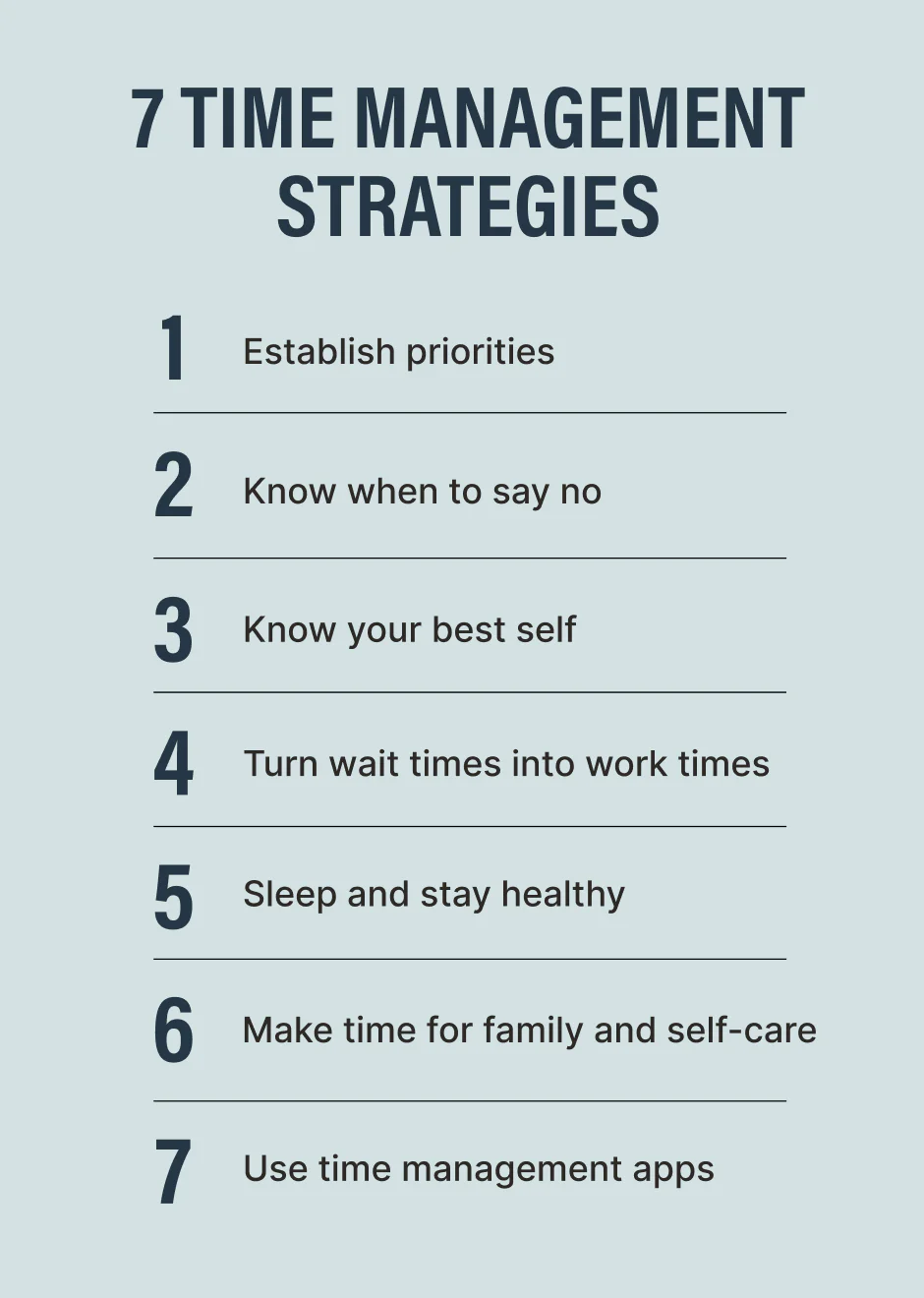
Getting started with time management can feel challenging, but small changes can make a big difference in how you manage your day.
Here are seven habit-based tips to help you take control of your time and stay on track.
You can’t do everything in one day. Prioritize your to-do list by putting urgent tasks first. You’ll often hear people call this strategy “Eat That Frog,” because it focuses on getting your most dreaded task (unless you love eating frogs) out of the way.
Effective prioritization is a key part of managing your time and projects. Consider which projects are due soon at work, what reading needs to be done, which class discussions are coming up, etc. Then make a list of your tasks and order them based on what needs to be done now and what can wait until later. You can do this daily or weekly – whatever you need to stay on track.
An Eisenhower Decision Matrix can help you sort tasks clearly. Place each task or goal into one of four categories.
For example, if you’re working full-time while pursuing your master’s degree, you might have a major work project and two course assignments due soon. Then your boss adds a mandatory conference to your calendar.
The conference has a set date, so that’s a Do first task. Your work project, due Thursday, also belongs in Do first. Because your course assignments have flexible deadlines, they can move to Schedule for the following week.
By setting clear priorities, you’ll reduce stress, focus on what truly matters and make steady progress toward your goals.
While it’s important to make time for things you enjoy, a big part of time management is recognizing the activities you can take a pass on. Examples include nice-to-have but non-essential activities that cut into your study time or disrupt your work-life balance.
For example, imagine you have a work presentation and an assignment due next week, and you’ve set aside the weekend to prepare for them. Then friends invite you on a quick trip out of town. If saying yes would disrupt your schedule and delay important goals, it’s OK to politely decline.
Are you a morning person? A night owl? Do you need complete peace and quiet to do your coursework, or are you more comfortable in the buzz of a busy coffee shop?
There are multiple university chronotypes when it comes to study habits, which is just a fancy way of saying that different students thrive in different environments. That might include the study location, time of day, the number of people in group study sessions or anything in between.
Knowing how and when you do your best work is essential for getting it done.
You never know when you’ll have a few minutes to spare. Always have your schoolwork with you in case you find yourself waiting an extra-long time for the bus or if you arrive early to an appointment.
Use these stolen moments for some reading or to prioritize your to-do list.
The FlexPath and GuidedPath learning formats from Capella allow you to access your coursework from anywhere at any time.
When you’re trying to get a lot done, it can be tempting to put healthy habits on the back burner. Getting enough rest, eating a balanced diet and staying active will help you be more productive each day. They’re also great ways to help reduce stress.
When blocking out your schedule, use a time management strategy that allocates time for rest. These also need to be a priority. Block out mealtimes, sleep times and exercise time and ensure your other tasks fit with these priorities (and not the other way around). This will keep your mind and body healthy.
Taking care of yourself and those around you is like getting enough sleep and adopting healthy habits. So give yourself time to reconnect with family or take some time to recharge. Both release stress and help you be more productive afterward.
In practice, this means using time-blocking to carve out an hour a day for activities such as going for a walk, reading a book or watching a movie with a friend. More importantly, you need to stick to it. When it’s time to go for a walk, close the laptop and get outside. The world won’t crumble while you take a break.
Need more time? There’s an app for that. Actually, several.
Whether you need help prioritizing to-do lists, staying focused or increasing your productivity, there are digital solutions and project management tools that you can research to see if they fit your study habits, such as:
This list of apps isn’t exhaustive and Capella University does not have affiliations with Toggl Track, Todoist, Notion or Evernote. Just like time management strategies, what works for your best friend might not be the right app for you. So, shop around and explore a few different scheduling or project management tools.
Some time management strategies are particularly effective if you’re a working student with a lot of responsibilities fighting for your attention.
To help you regain control of your schedule and start reaping the rewards of time management, here are five of our favorite strategies.
The Pomodoro Technique is a popular time management method that uses short, focused work intervals to boost concentration and productivity.
If you know a little Italian, you know that “pomodoro” means “tomato.” The inventor of this technique, Francesco Cirillo, used a tomato-shaped timer to time his study sessions.
Pomodoro breaks big projects into manageable chunks (or “pomodoros”) so that you reduce procrastination and stay mentally fresh.
Here’s how it works:
This approach is especially useful if you’ve got a big project coming up and you’re feeling overwhelmed.
Getting Things Done (GTD) is a time management system created by productivity expert David Allen. It’s designed to help you capture everything on your plate, organize it clearly and act on it with confidence.
Here’s how it works:
For example, if you’re pursuing your BS in Health Care Administration while working full time, you might start by capturing everything you need to do this week, like reviewing staff schedules, preparing departmental reports and coordinating team meetings.
Next, you’d clarify what each task requires and how long it will take. Then, you’d organize them by category and deadline.
At the start of each day, you would reflect on your list and choose one high-priority item to complete first. By the end of the week, you’d have a clear record of progress and a calm sense of control – key goals of the GTD method.
The Rapid Planning Method (RPM) is a time management system developed by life coach and motivational speaker Tony Robbins. It’s an alternative to to-do lists that focus on why something matters, instead of including everything you want to do (or think you need to).
Here’s how it’s broken down:
The RPM strategy is particularly helpful if you’re trying to build short-term tasks around a bigger long-term goal. For example, let’s say your goal is to earn your MBA within two years. To manage your time effectively while studying, you would use RPM to break your course down into 10-week quarters. Your plan might look like this:
Using RPM, each daily task in your action plan is a reminder of the results you’re trying to achieve and why you’re doing it all in the first place.
The Pareto Principle is a time management approach that helps you focus your energy where it counts most. Also known as the 80/20 rule, it’s based on the idea that 80% of your results come from 20% of your efforts.
Here’s how it works:
This method is especially useful for working professionals and Capella students balancing multiple priorities. It helps you recognize which activities move you closer to achieving your goals, so you can spend more time on what truly matters and less on what doesn’t.
For example, imagine you’re a working parent pursuing your online Master of Social Work, facing a full week ahead. Using the Pareto Principle, you’d start by identifying your high-value tasks: attending a parent-teacher conference on Tuesday, presenting to new clients at work on Thursday and finishing a paper on human behavior by Friday.
To stay focused, you could postpone lower-priority tasks like batch cooking, ordering that bathroom rack or comparing car insurance quotes until the following week. By centering your time on your most important goals, you make meaningful progress without burning out.
Time blocking is a time management strategy that helps you take control of your day by dividing it into dedicated “blocks” of time. Each block is reserved for one task only, helping you see your schedule clearly and understand what you realistically have time to accomplish.
With that clarity, it becomes easier to prioritize your work and stay organized around your existing commitments.
Time blocking can be used as an alternative to the Pomodoro technique. Instead of breaking work into short bursts of focus, time blocking helps you plan for longer, more intentional work sessions that match your energy and schedule.
Here’s how to get started:
Time blocking is especially helpful if you’re studying part time while managing work, family or caregiving responsibilities.
For example, if your priorities this week include writing a market research report with your team, getting the kids to soccer practice, visiting your mom and studying two hours a day toward your online degree, you’d schedule each activity on your calendar and add 30-minute breaks between them.
When it’s time to study, turn off notifications and focus fully on your coursework. When it’s time for family or rest, step away from work. Over time, these consistent habits can help you stay balanced and productive.
Ultimately, there’s no magic wand when it comes to time management for adult students. It’s a cumulative process. But if you can identify and apply a time management strategy that aligns with your lifestyle, you’ll sharpen your priorities, get clarity on your targets and improve your work-life balance. It also helps to enroll in a degree program that fits around your busy life.
That’s why so many students benefit from Capella University’s unique FlexPath learning format. It allows you to set your own deadlines, helping you fit a degree into your existing schedule. Learn more about what you can achieve with FlexPath.
The best strategy for managing your time depends on your existing lifestyle, workload and priorities. It’s worth exploring multiple time management strategies to decide how each method aligns with your goals before committing to a particular strategy.
Useful time management strategies for students include the Pomodoro Technique, Getting Things Done, the Rapid Planning Method, the Pareto Principle (or “80/20 rule”), and time blocking.
The Pickle Jar theory is a time management technique that uses the metaphor of a jar to help you prioritize tasks. The jar represents available time. Your top priorities are represented by rocks, less important tasks are pebbles and everything else is sand.

We've received your message and will get back to you soon.