
By: The Capella University Editorial Team
Reading Time: 8 minutes
Every PhD begins with a question no one has fully answered before. Turning that question into original research and defending it through a dissertation is what defines a scholar.
A PhD dissertation is a rigorous study that adds new insight to a discipline and proves a scholar’s credibility. Find out what a PhD dissertation is, how the process unfolds and the format you’ll follow to bring your research to life.
A dissertation is an in-depth, original research project that demonstrates the expertise and independent research skills a student has acquired during their PhD program.
It’s usually made up of several sections:
While not all doctoral programs require a dissertation, it is typically a component of PhD programs. PhDs are designed to develop advanced research, analytical and critical thinking skills. The main goal is to create independent scholars who can contribute new knowledge to their field.
A PhD program can prepare you for a career in academia, research, leadership or specialized professional roles. You can pursue a PhD in many areas, including business, management, information technology, science and social sciences.
A dissertation is a common final project for a doctoral program, but, depending on your specific program and type of doctorate, you could be required to complete a doctoral study, capstone project or similar research projects.
Find the right doctoral program with Capella. Explore our online PhD programs now.
Both dissertations and doctoral studies are major research projects required to complete a doctoral degree. The main difference lies in their purpose and approach.
A dissertation focuses on creating new knowledge. Students design original research, collect and analyze data and present findings that expand understanding in their academic field.
A doctoral study or capstone project is typically part of an applied or professional doctorate. Instead of producing a new theory, it uses existing research to address a real-world problem in a professional setting. Students identify a challenge in their field, apply evidence-based methods to solve it and evaluate the results.
Understanding these differences can help you choose the program that best fits your goals. If you’re drawn to research or teaching in academia, a PhD dissertation may be right for you. If you want to use research to drive practical change and innovation in your career, a professional doctorate with a capstone or doctoral study may be a better match.
Jonathan Gehrz, EdD, Academic Director, Capella University, highlights these distinctions: “A dissertation for a PhD program focuses on unique contributions and ways to bring new knowledge to the discipline. Some doctoral programs require capstone projects, which are focused more on applying theory to different settings.”
Here’s a table showing the key differences between a dissertation and doctoral capstone at a glance:
To choose the right doctoral program for you, Dr. Gehrz advises, “Whatever your goal is, think about how you’re going to apply your education and the relevance that it has in that space.”
Whether your path leads to a dissertation or an applied doctoral project, Capella’s online programs and scholar-practitioner faculty are here to guide you every step of the way. Next, let’s look more closely at what the PhD dissertation process involves and how Capella supports you from your first idea to your final defense.
Completing a dissertation is one of the most rigorous and rewarding parts of earning a doctoral degree. While every university has its own requirements, the overall process follows a series of structured steps, from choosing a topic to defending and submitting your final research.
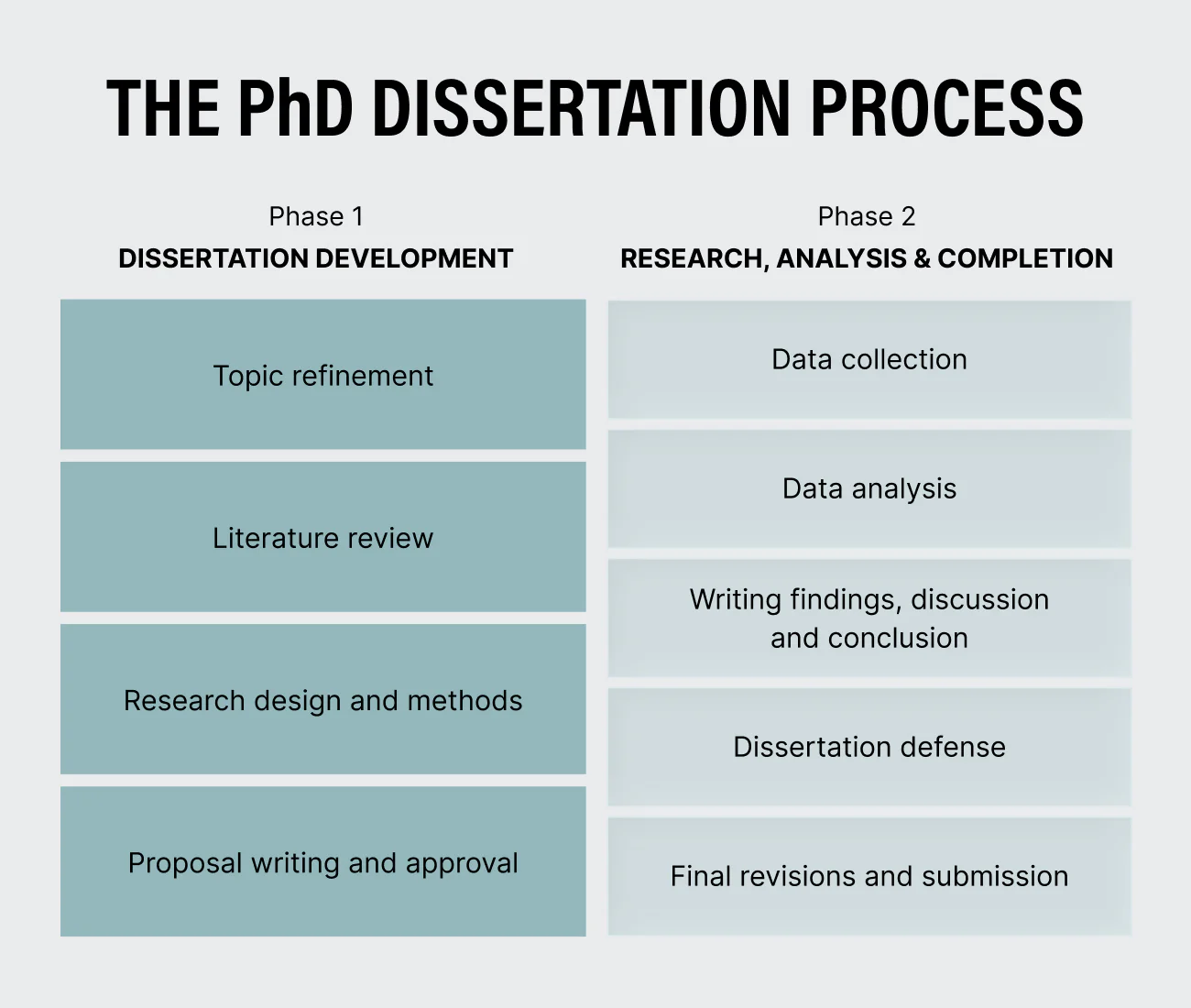
Early in your PhD program, coursework and faculty guidance help you narrow down your interest into a clear researchable question. A strong topic should be original, relevant and feasible within your field of study.
At Capella, scholar-practitioner faculty help students connect their research ideas to current issues and trends in their professions and develop them into something that will add to the body of knowledge in their chosen field.
After defining your topic, you’ll develop a detailed research proposal outlining your goals, methods and expected outcomes. This stage often includes a preliminary literature review and methodology plan, which are submitted for committee approval.
Students work with a faculty mentor during this process. Capella also provides expert support through academic coaches.
The literature review establishes the foundation for your doctoral research. You analyze existing studies related to your topic to identify key themes, debates and gaps that your work will address. This stage also helps you build a conceptual or theoretical framework that guides the rest of your dissertation.
Once your proposal is approved, you can start conducting your research and collecting data for analysis. Research may be qualitative, quantitative or mixed-methods, depending on your discipline and goals.
You then analyze the raw data to discover patterns and answer your research question. Programs such as Capella’s offer digital research tools and structured milestones to help students stay on track throughout this intensive phase.
The goal of a dissertation is to present your research findings in a structured, academic format.
Your dissertation must follow the formatting guidelines set by your university, but it typically includes:
Editing and formatting are crucial for clarity and consistency. Capella University offers writing support through the Writing Center. Our support services are available online, making it easier for working professionals to access help as they write.
Most (though not all) PhD programs require an oral defense of your dissertation before a committee.
This is your opportunity to present your findings, explain your methods and answer questions posed by the committee members. In some cases, a dissertation is approved with recommendations for required revisions.
After you’ve addressed any feedback and your dissertation is approved, you submit the final version to your university for review and archiving. Many graduates also publish their findings in journals or present at academic conferences to share their contribution with the wider research community.
Completing a dissertation demonstrates advanced scholarship and perseverance. Universities like Capella combine structured milestones, expert mentorship and flexible online support, helping students complete each stage with confidence while balancing their professional and personal commitments.
Learn more about the dissertation development and approval process at Capella University.
The format of your dissertation can vary based on your program and university requirements.
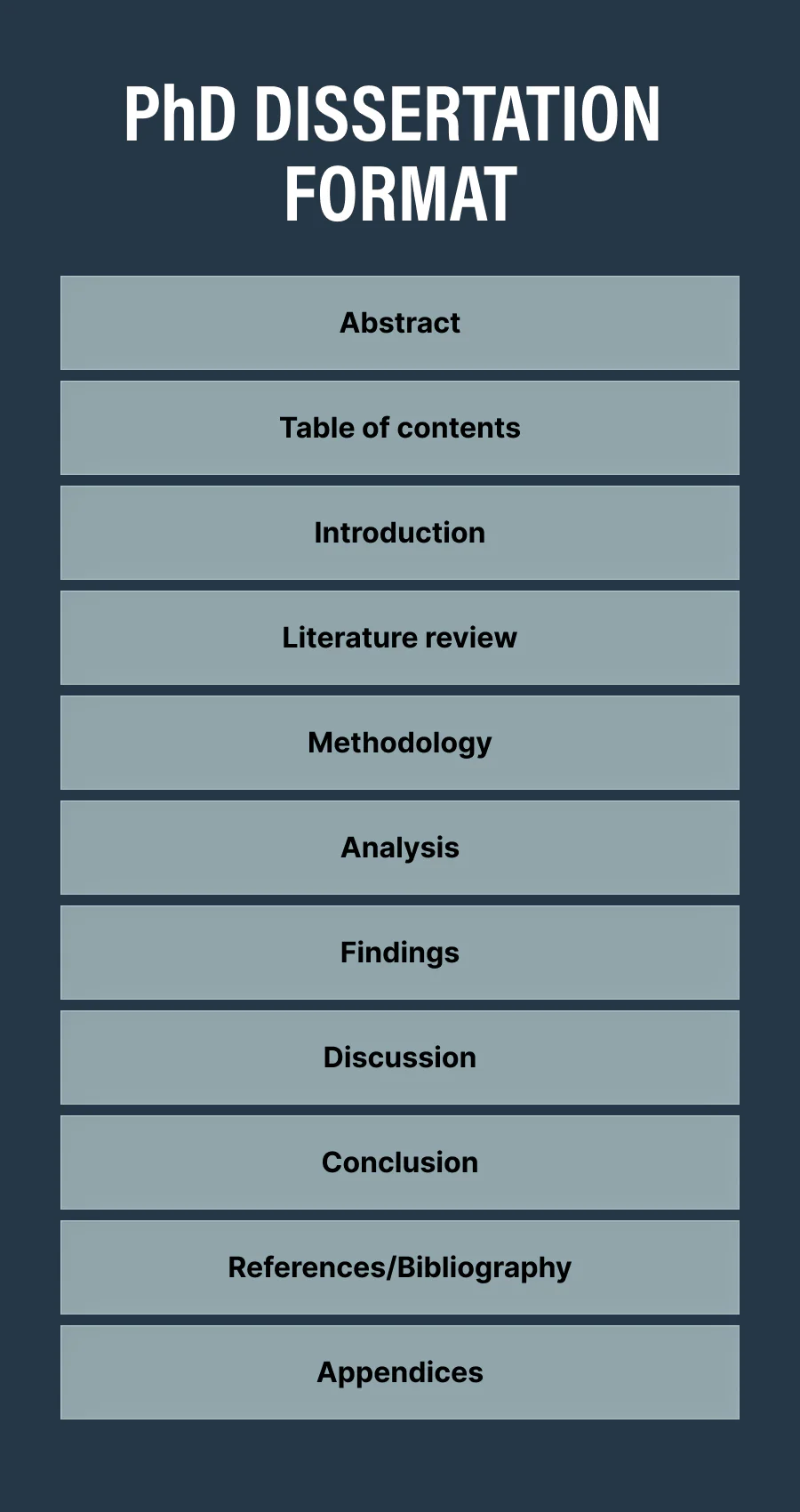
It usually involves:
Completing your dissertation marks the culmination of years of study and research, and the beginning of your contribution to your field.
A PhD helps you build the expertise to challenge ideas, uncover new insights and lead progress in your field. Through the dissertation process, you gain advanced research, analytical and communication skills that define true scholarly leadership.
Capella University’s online PhD and professional doctoral programs help you grow as a scholar-practitioner ready to apply research to real-world problems. Connect with an enrollment specialist to explore programs that can help you take the next step in your academic and professional journey.
Start your doctoral journey with Capella today. Talk to our enrollment specialists now.
A PhD dissertation typically ranges from 100 to 300 pages, depending on the field, topic and research depth.
Yes. Some PhD programs offer alternatives, such as a doctoral study instead of a traditional dissertation.
Online PhDs are well-regarded when they are from an accredited university. When exploring online PhD programs, review the accreditations of each university to ensure they are recognized and relevant to your field.

We've received your message and will get back to you soon.