
By: The Capella University Editorial Team with Lisa Kreeger, PhD, RN, Executive Dean, Healthcare Center of Excellence and Strategy
Reading Time: 8 minutes
You want to make a real difference in people’s lives, but between work, family and everything else on your plate, finding time for an online social work degree can feel challenging.
Yet you may not need a dramatic life change to get started. Many online social work programs are built with working adults in mind, with structured weekly expectations for coursework and clear timelines for the in-person field experiences you’ll need. You can take steady, planned steps toward your goals each term without stepping away from your other responsibilities.
You don’t have to pause your life to move toward the future you want.
Explore what an online social work degree covers, how bachelor’s, master’s and doctoral programs in social work are set up, how fieldwork fits into real life and how to decide which path may be right for you.
Ready to grow in the field of social work? Explore Capella’s online social work degree programs.
An online social work degree introduces the knowledge and practical skills needed to support individuals, families and communities. While program structures vary by university, reviewing each institution’s specific requirements can help you understand how well its approach aligns with your goals.
Many social work programs include coursework that explores areas such as:
A bachelor’s program generally introduces the principles of generalist practice. A master’s program may include deeper study in areas such as assessment, intervention and leadership. Doctoral programs tend to focus on advanced practice, research or leadership roles within the field.
Education in the field is also an essential component of accredited social work programs. It gives students the opportunity to apply classroom learning in real community settings under supervised guidance. Because practicum expectations differ by institution and state, it is important to review the requirements that apply to the program you choose.
No university can guarantee licensure or certification. Students are responsible for reviewing the regulations in their own state. For further information, take a look at state licensure requirements here.
At Capella, the social work offerings include an Bachelor of Social Work (BSW), a Master of Social Work (MSW), MSW – Advanced Standing and a Doctor of Social Work. These programs are designed to support students with guidance from scholar-practitioner faculty and structured preparation for coursework and field education planning.
Social work degrees build on one another. Students can enter at different levels depending on their background. Here’s how the degrees relate to each other.
A BSW is often the starting point for individuals entering the field. It introduces generalist practice, human behavior, social welfare policy and ethical foundations.
With this degree, students can explore roles in settings such as:
Availability of these settings can vary based on your background, experience and local or employer-specific requirements. A BSW may help you build the foundational skills needed to begin working in a range of human service environments.
The MSW is the next academic step for those who want to deepen their skills or prepare for advanced or clinical practice. Coursework often includes assessment, intervention, leadership and specialized practice methods.
Students with a CSWE-accredited BSW may be eligible for a MSW – Advanced Standing program.
With an MSW, you can explore further roles in settings such as:
Requirements for working in these settings can differ by state and employer, so it’s important to research expectations for your intended career path. Many states require an MSW for certain licensure pathways. State requirements vary, and students are responsible for reviewing the regulations in the state they plan to practice.
A DSW is an advanced practice degree designed for professionals who already hold an MSW and want to expand their leadership, teaching or administrative skills.
Coursework may strengthen evidence-informed decision making, program evaluation and professional leadership.
With a DSW, students may explore opportunities in settings such as:
These settings are examples only. Requirements can vary by employer, state and role, and may include licensure, certification or prior experience. It may also support pathways to roles like adjunct instructor, supervisory social worker or director-level positions, depending on individual experience and state requirements.
Online coursework is structured to support students who are balancing work, family and other responsibilities.
In Capella’s social work programs, coursework is delivered in the GuidedPath learning format, which provides weekly deadlines and 24/7 courseroom access. Assignments follow a set schedule that helps you plan steady progress quarter by quarter.
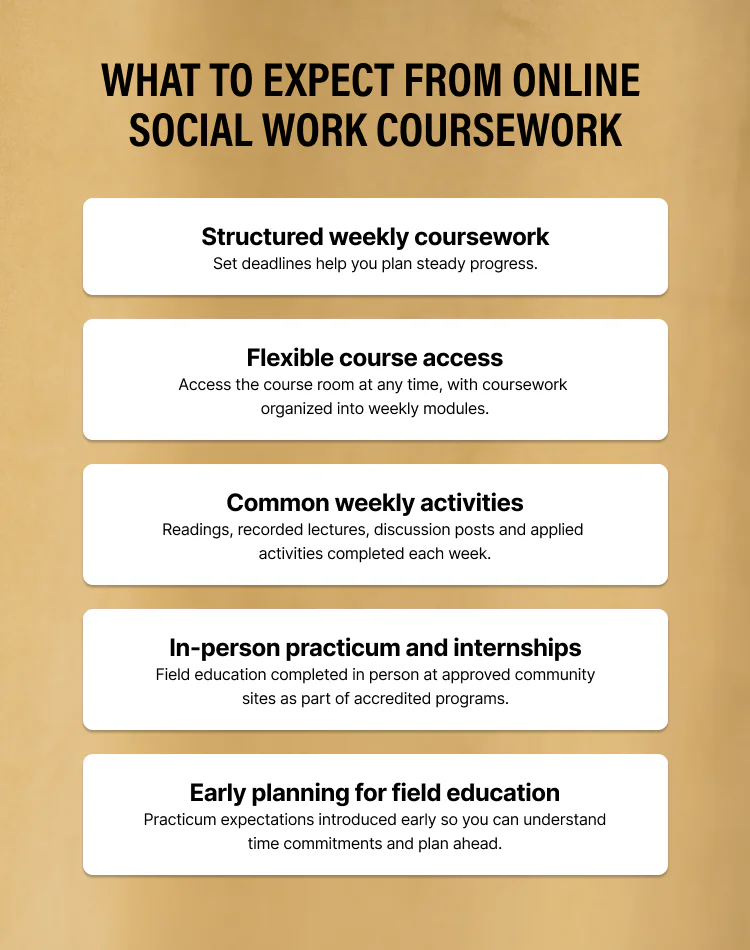
A typical week may include reading assignments, recorded lectures, discussion posts and applied activities. Since courses are organized in weekly modules, many students choose to set aside consistent study blocks to stay on track and maintain predictable routines.
Although coursework is completed online, accredited social work programs also include practicum and internship requirements that take place in person at approved community sites.
These experiences are introduced early in the program, allowing you to understand the time commitment and plan ahead for field education. GuidedPath’s structured format, regular instructor feedback and pay-per-credit tuition model can help you organize your learning and prepare for upcoming field experience steps.
Site-based learning is an essential part of accredited BSW and MSW programs because they give students the opportunity to apply what they learn in real practice environments.
Site-based learning typically includes both practicum and internship hours that follow CSWE standards. These supervised experiences may involve meeting with clients, collaborating with community partners, strengthening documentation and communication skills and building confidence in your developing social work practice.
Many working adults want to understand how site-based learning fits into an online format. In most cases, placements occur within your own community, and universities outline the requirements early so you can begin planning.
Common placement sites may include:
These hands-on hours are an important part of meeting accreditation expectations, and they may help prepare students for state licensure requirements, which differ across states.
Reviewing the guidelines in your program and state can give you a clearer sense of what to expect as you move toward practicum and internship steps.
Capella’s social work programs are designed to give you a clear sense of direction from your first course onward.
Program plans outline what to expect at each stage so you know how your coursework, practicum and internship steps fit together and when major milestones typically occur. This upfront structure can help you feel more confident about managing your time alongside work and other responsibilities.
Throughout your program, you can connect with your academic coach whenever you need support with planning, staying organized or preparing for upcoming requirements. This guidance helps you move through each term with more clarity and gives you a place to turn when questions come up.
Field placement coordination is another way Capella supports you as you prepare for practicum and internship work. You receive information on documentation, site expectations and timelines so you can begin planning early for the in-person components of your degree.
As you progress, you complete your coursework in an online format built to fit into a busy life, with structured weekly expectations and resources that help you navigate both academic and field-related responsibilities.
Exploring a future in social work begins with finding a program that fits your goals, life responsibilities and the timeline you have in mind. As you consider your next step, look for options that offer clear structure, predictable weekly expectations and early guidance on field education so you can plan with confidence.
If you’re looking for an online path that supports working adults, Capella’s social work programs help you move forward with a format that offers weekly deadlines, faculty guidance and dedicated support for practicum and internship planning.
All set to move forward in your social work career? Explore Capella’s online social work programs.
Timelines vary by program. Some universities offer degree-completion options at the bachelor’s level for students who already have prior credits. At the master’s level, students with a CSWE-accredited BSW may qualify for a MSW – Advanced Standing program that shortens completion time. Each school sets its own structure.
Many online MSW programs are accredited by CSWE, which is the key marker of quality for social work education. Licensing rules differ by state, so students should confirm that any online MSW they’re considering meets the requirements where they plan to practice. No university can guarantee licensure.
Fully tuition-paid degree programs are uncommon, but many students use financial aid, grants, scholarships, employer assistance or tuition-savings opportunities. Exploring available financial support can help reduce overall costs if you’re eligible.

We've received your message and will get back to you soon.